Test against the attacks relevant to your organisation
Scope red teams and validation around the techniques, controls and at-risk products active against organisations like yours.


The Problem
Pen tests run from a standard playbook that drifts from what real adversaries do. You can pass a test that does not resemble the attack you will face.
Questions this page answers
Which techniques relevant to us are active now?
Which products of ours are most at risk?
Which attacker behaviours should we emulate?
Which controls should detect this activity?
Which groups are exploiting CVEs in our stack?
What evidence supports the test scenario?
How Lupovis helps you test what matters
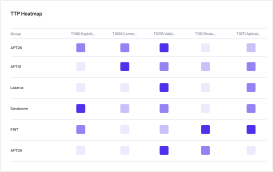
Scope from relevant tradecraft.
Unlike a fixed methodology, the MITRE Timeline and TTP Browser scope the test from techniques active against organisations like yours.
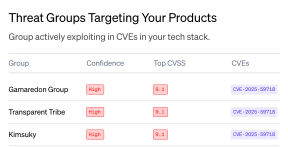
Target your at-risk products.
Products at Risk ranks your stack by exploitation likelihood and names the groups exploiting CVEs in it, so testing hits the real exposure.
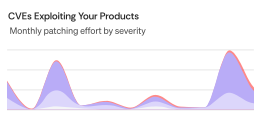
Emulate observed behaviour.
Each technique lists its method and the source IPs performing it, so testers reproduce real tradecraft.
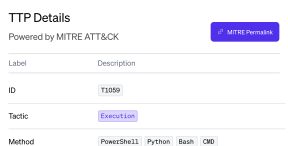
Validate your controls.
Each technique names the controls expected to catch it, and the hunting rules let you confirm whether yours would have.
Data available
Field
Why it matters
Action
TTP protection controls
Shows the common controls that protect against this technique.
Action
TTP exploit method
Shows how to check whether you are vulnerable to this technique.
Attribution
Group Infrastructure links
Shows infrastructure linked to known threat groups.
Attribution
Group name
Gives you a common name for each threat group.
Attribution
Group country
Shows the country the group is linked to.
Attribution
Motivation
Shows why the group has attacked organisations in the past.
Attribution
Sectors observed
Shows which sectors the group is known to target.
Attribution
Countries observed
Shows which countries the group is known to target.
Attribution
TTP IDs linked to the group
Shows the techniques the group has used before, so you can see how it might attack you.
Behaviour
TTP Description
Explains what a technique involves beyond its name or ID.
Behaviour
Kill-chain stage
Shows which stage of an attack the technique is used in.
Behaviour
MITRE ID
Gives you the standard ATT&CK reference for the technique.
Observed signal
CVEs observed
Shows which CVEs this IP address has tried to exploit before.
Observed signal
Behaviour and techniques identified
Shows which techniques this IP address has used before.
Threat detail
Affected product
Shows which product the vulnerability affects.
Threat detail
CPEs
Gives the official product and vendor string used across security tools.
Threat detail
Published date
Shows when the CVE was announced.
Threat detail
CVSS score and level
Shows how severe the vulnerability is on the standard scale.
Threat detail
EPSS score
Shows how likely the vulnerability is to be exploited.
Threat detail
KEV status and date
Shows whether the vulnerability has been exploited in the wild and since when.
Test what is actually coming for you.
Explore other use cases

Stop breaches before they happen
Get a 30-minute walkthrough with the Lupovis team. We'll show you activity already targeting organisations like yours.